Recipes and Recommendations for Imbibing Beauty through Books and Beverages
By Annie Nardone
THE PAGES: cONFESSIONS BY sAINT aUGUSTINE
“The thought of you stirs him so deeply that he cannot be content unless he praises you, because you made us for yourself and our hearts find no peace until they rest in you.”
—Saint Augustine, Confessions

Are you intimidated by the idea of reading Saint Augustine’s Confessions? Don’t be. This book is Augustine’s plain-spoken, personal journey as witness to his own depravity and his meeting with God’s enduring faithfulness.
I have scarcely read a Christian testimony that is so humble and honest and can be briefly summarized as introspective, childlike, and joyful. He doesn’t mince words while he shares his sinfulness. When Augustine leaves home to study at university, he writes, “I went to Carthage, where I found myself in the midst of a hissing cauldron of lust. . . . I muddied the stream of friendship with the filth of lewdness and clouded its clear waters with hell’s black river of lust.” He makes no excuses.
But because the book is written as self-reflection, Augustine shares with the reader how he can see that God was at work. And similar to David in the Psalms, Augustine is purely astounded at the goodness and mercy of God, recognizing that “. . . all the while, far above, your mercy hovered faithfully about me; I exhausted myself in depravity, in the pursuit of an unholy curiosity.”
What makes Augustine’s Confessions so endearing? He is each of us, the stumbling, sinful, and broken human who tries and fails. I hear Augustine say, “UGH, I was a sexual deviant, cult member, status worshiper, [fill in the sin here], and God, you still love me! Praise be!”
Here’s a little of his back story. Saint Augustine of Hippo was born in AD 354 to a pagan father and a Christian mother, Monica, who was a steady, prayerful influence on his life. Augustine left for Carthage at sixteen to continue studying law, but was drawn to philosophy. He joined the Manichean religion for a time, then became a professor in Milan, studied Neoplatonism and the preaching of St. Ambrose, and finally converted to Christianity in AD 387. The last thirty-four years of his life were devoted to serving as Bishop of Hippo.
I find this ancient tome so refreshing. Augustine models to me how I can come to God, no matter what I’ve done, whispering, “Oh Lord, I’ve fallen again. Please forgive me.” And as with Augustine, I am forgiven and loved by God.
C.S. Lewis tells us in his essay, “On the Reading of Old Books,” that a student “is half afraid to meet one of the great philosophers face-to-face. He feels himself inadequate and thinks he will not understand him. But if he only knew the great man, just because of his greatness, is much more intelligible than his modern commentator.” Augustine is infinitely readable and relatable because his confessions are our confessions. Poor decisions, ill-chosen relationships, and tangled spiritual journeying are part of the human condition. It’s a comfort to read that this “great man” and philosopher struggled like us.
“I have learnt to love you late, Beauty at once so ancient and so new! I have learnt to love you late! You were within me, and I was in the world outside myself.
—Saint Augustine, Confessions
PINTS AND POURS
In Confessions, Augustine shares a bit about his time with the Manichees cult. Unsanctified members like Augustine were expected to commit the sin of picking figs for the elect. He notes that “if some sanctified member of the sect were to eat the fig . . . he would digest it and breathe it out again in the form of angels or even as particles of God.” These fig-inspired alcoholic and mock beverages are delightful, but I can’t promise that you’ll breathe out angels.
There is a fig vodka available, and I think it would make a lovely martini, but I am abiding by the practices of the early Middle Ages for the following cocktail.

Manic-Ease
10 oz. dry, chilled mead
1-2 tsp. fig syrup (recipe below)
Fig slice
Pour chilled mead into a cold stein or rocks glass. Add fig syrup, stir, and garnish with a fig slice.
Carthage Cooler
1 6.8 oz bottle of elderberry tonic water (I like Fever Tree)
1 tsp. fig syrup
1 tsp. fresh lemon juice
Lemon twist and a fig slice for garnish.
Fill a tall glass with ice. Add lemon juice and fig syrup, then pour elderberry tonic over ice and stir. Garnish pick with lemon twist and fig and rest on rim.
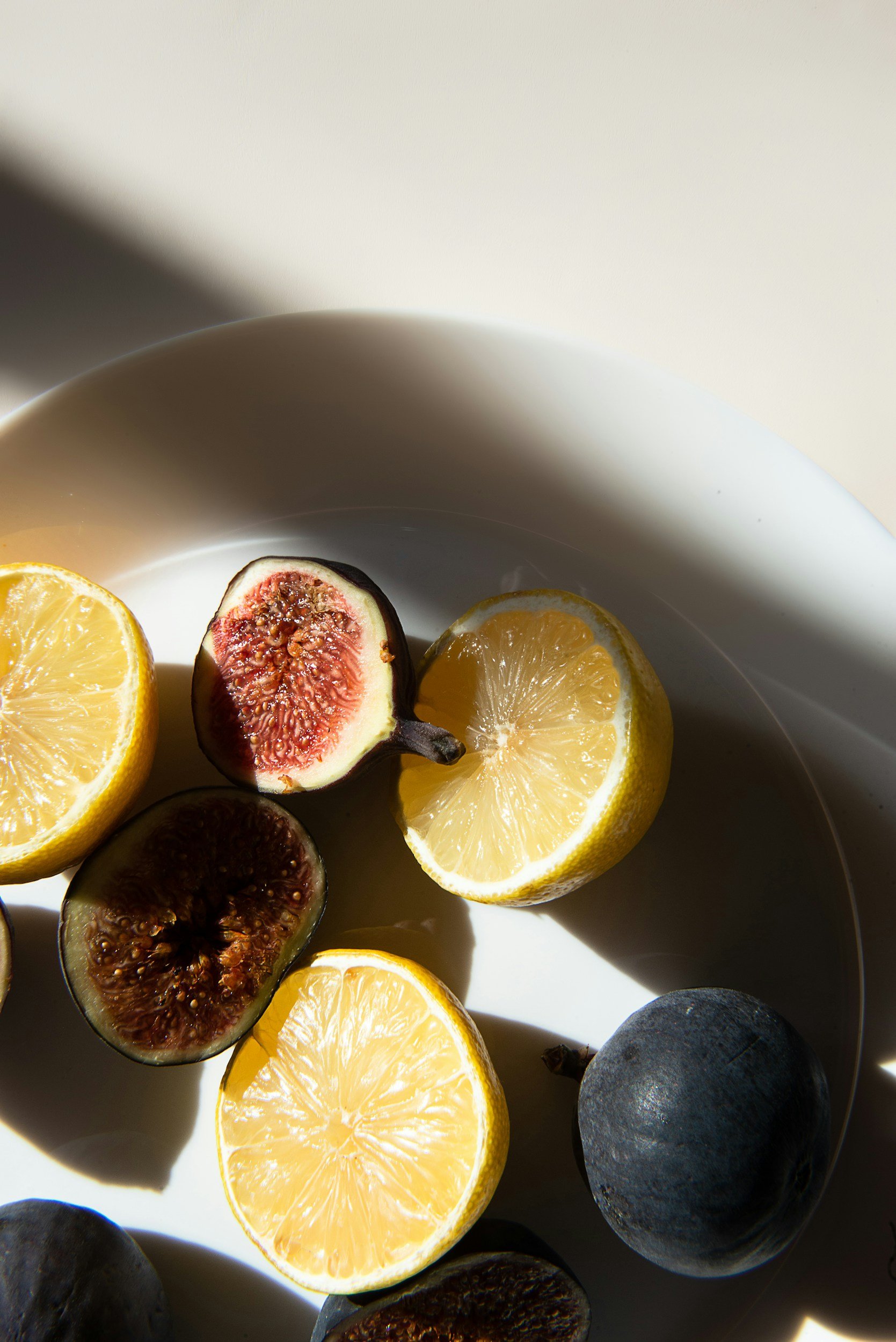
Fig Syrup
8 oz. dried figs, coarsely chopped
1 cup sugar
1 cup filtered water
1 T. fresh lemon juice
Combine all ingredients in a heavy saucepan. Simmer and stir over medium heat until sugar is dissolved. Continue simmering for ten minutes until figs are tender. Cover the pot, remove from heat, stir, and steep for 20 minutes.
Strain fig liquid through a fine sieve. Keep figs for another use (baking, jam). Return fig liquid to pan and cook on low until syrup is thickened, about 15 minutes. Transfer to a glass jar and let cool. Apply lid and refrigerate. It keeps in the fridge for two weeks.
Annie Nardone is a lifelong bibliophile with a special devotion to the Inklings and medieval authors. She is a Fellow with the C.S. Lewis Institute and holds an M.A. in Cultural Apologetics from Houston Christian University. Annie is a writer for Cultivating Oaks Press and An Unexpected Journal. Her writing can also be found at Square Halo Press, Rabbit Room Press, Clarendon Press U.K., Calla Press, and Poetica. Annie is a Master Teacher with HSLDA and Kepler Education and strives to help her students see holiness in everyday life and art. She lives in Florida with her husband and six cats, appreciates the perfect cup of tea, an expansive library, and the beach with family.
lISTEN WHILE YOU SIP
Check out our Latest Imagination Redeemed Podcast Episode!
[Augustine quotations are sourced from Confessions by Saint Augustine (Penguin Classics). Lewis's essay may be found in God in the Dock: Essays on Theology and Ethics (Eerdmans).]