Recipes and Recommendations for Imbibing Beauty through Books and Beverages
By Annie Nardone
THE PAGES: Ecclesiastical History of the English People by the Venerable Bede
“For if history records good things of good men, the thoughtful hearer is encouraged to imitate what is good: or if it records evil of wicked men, the devout, religious listener or reader is encouraged to avoid all that is sinful and perverse and to follow what he knows to be good and pleasing to God.”
—Bede, Ecclesiastical History of the English People
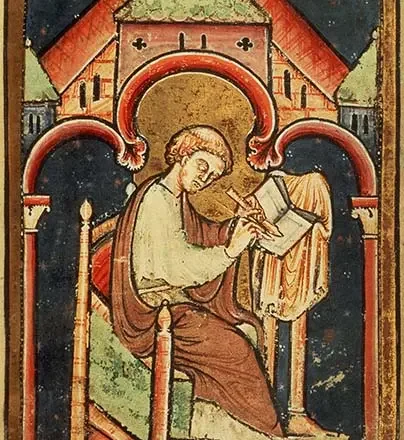
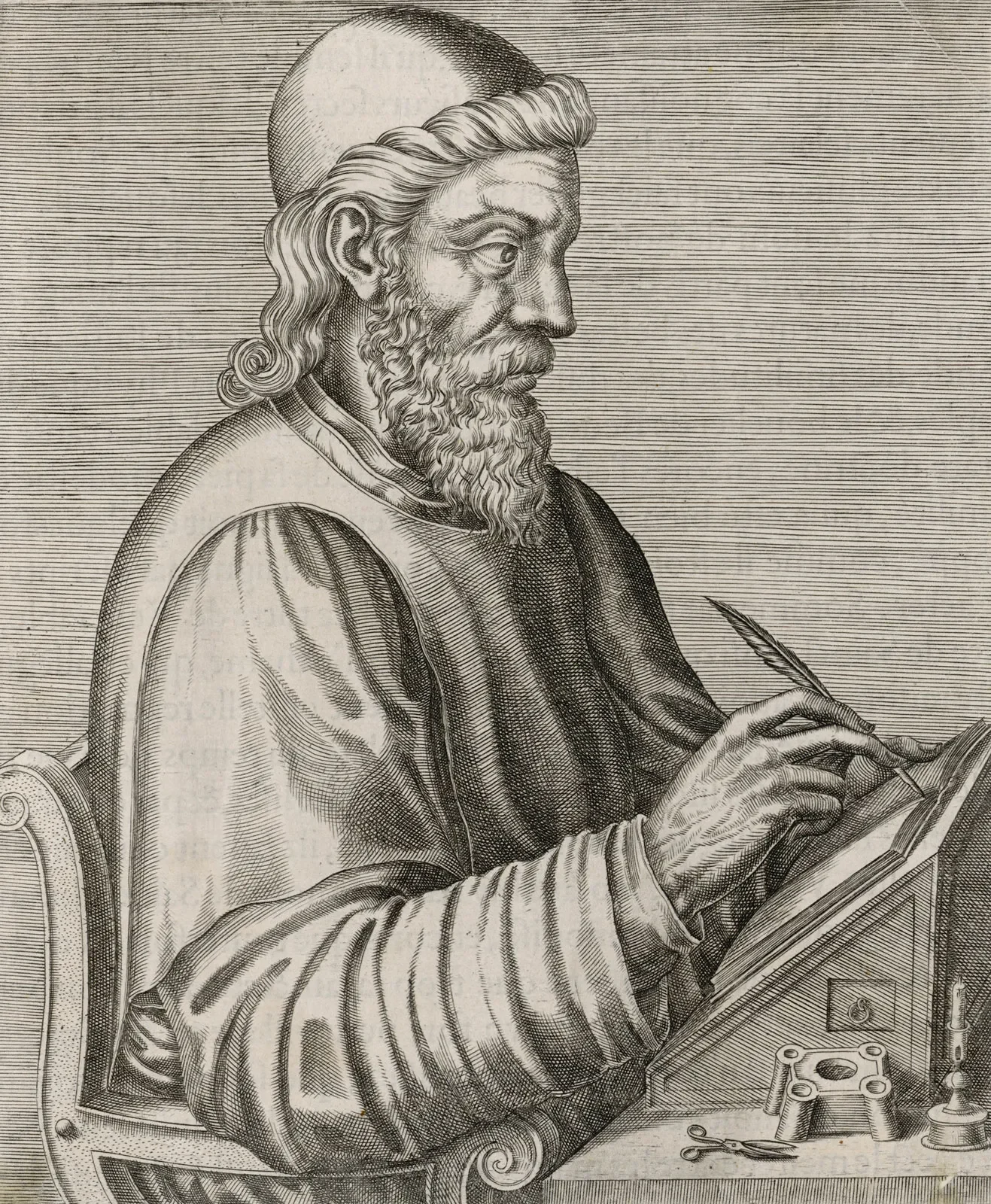
Portrait of Bede, from a 12th-century copy of his Life of St. Cuthbert, British Library (thomryng.com)
It was a time of nobility, bloody battles, and pure devotion to God’s call. Europe’s early medieval period brought us some of the most brilliant and inspirational writing the world has known.
The Venerable Bede’s Ecclesiastical History of the English People, completed in A.D. 731, is the story of England’s Christian history. It also stands alone as a pivotal account of early Britain. Bede, a priest and historian, collected historically important stories from abbots, monks, and archbishops to create this fascinating narrative timeline of the advancement of Christianity throughout ancient Britain.
Bede’s history actually begins before the birth of Christ with the invasion by Gaius Julius Caesar, and goes on to provide a record of the advancement of Christianity—against incredible odds—across Europe. The text was first known throughout Northumbria. It then became widely shared during the Middle Ages and was finally printed in 1480.
Why read a history book written in the eighth century? For the glory of the story! Bede’s text resonates with the beautiful “eucatastrophe” of earliest Christianity—the humble faith and bravery required to face battles, disease, and death for a holy calling. Throughout this work, there is a profound sense of the temporal nature of man, and the inevitable eternity of heaven or hell.
In many ways, this early medieval history reminds me of Tolkien’s The Lord of the Rings and the history of Middle Earth. Humble, hobbit-y monks and nuns journey into the unknown wilderness to establish new monasteries and to convert the people to Christianity. Dark peril looms! But a flicker of hope endures, often kept alit by the quiet, common folk who are named in this book.
Among the fascinating details that Bede includes, we learn that the “English nation” witnessed a passionate return to education and the establishment of schools, with King Alfred and Charlemagne at the forefront of the movement. Another interesting fact: Bede records how the Roman Catholic Church set the standard on the logical and canonical time of keeping Easter, which is still followed to this day.
Many of the stories focus on end-of-life accounts. The final chapter was written by Cuthbert, Abbot of Jarrow, who witnessed Bede’s final moments. As he lay dying, Bede was able to fathom the final life passage as a holy mystery.
One of the most inspirational tales concerns the life of Caedmon, an illiterate monastery cowherd who lived at what is now known as Whitby Abbey. Bede states that he was “singularly gifted by God’s grace” with the ability to listen to a passage of scripture and “turn it into delightful and moving poetry.” Bede wrote that Caedmon was inspired by a vision of a man who told him to “Sing about the Creation of all things.” Caedmon’s songs were written down and he is still recognized as the first Old English poet.
Bede dedicated Ecclesiastical History of the English People to “the Most Glorious King Ceolwulf," who wished that his people would deeply value their history and emulate the faithful who had brought Christianity to England.
Don’t let medieval writing intimidate you! The Penguin Classics edition of Bede’s Ecclesiastical History of the English People is very readable. It contains Bede’s Preface, a helpful outline of the history and introduction by the translator, maps, and thorough genealogies and endnotes.
“And thus, on the floor of his cell singing: ‘Glory be to the Father and to the Son and to the Holy Spirit’ and the rest, he breathed out his spirit from his body. And it should be believed without doubt, that because he had always worked hard in the praise of God, his soul was carried by angels to the joy of Heaven which he desired.”
—Cuthbert, “Letter on the Death of Bede”
PINTS AND POURS
Medieval monastery life included blending botanicals, alcohol, and fruits for healing medicines as well as an income source. I’m not sure what Bede was distilling in A.D. 731, but Chartreuse, the oldest recorded monastery liqueur, was created in 1605 by the Carthusian Order founded in 1084 by St. Bruno at Grande Chartreuse, France. The Carthusian monks still own the original recipe that uses 130 plants and herbs distilled in grape alcohol.

SAXON SIP
2 oz. London Dry Gin
½ oz. Chartreuse
2 dashes orange bitters
Twist of lemon peel
Pre-chill a coupe or stemmed glass and peel a twist of lemon zest. Pour ingredients into a cocktail shaker, add ice, stir, and strain into the chilled glass. Twist the lemon peel over the drink, then add to rim.

OSWALD’S GARDEN MOCKTAIL
2 parts Seedlip Garden 108 (non-alcoholic spirit)
1 part ginger ale
1 small sprig of rosemary
Fill a tall glass with ice. Pour Seedlip over ice, then add ginger ale. Slip a rosemary sprig into the glass for an herbal touch.
Annie Nardone is a lifelong bibliophile with a special devotion to the Inklings and medieval authors. She is a Fellow with the C.S. Lewis Institute and holds an M.A. in Cultural Apologetics from Houston Christian University. Annie is a writer for Cultivating Oaks Press and An Unexpected Journal. Her writing can also be found at Square Halo Press, Rabbit Room Press, Clarendon Press U.K., Calla Press, and Poetica. Annie is a Master Teacher with HSLDA and Kepler Education and strives to help her students see holiness in everyday life and art. She lives in Florida with her husband and six cats, appreciates the perfect cup of tea, an expansive library, and the beach with family.
lISTEN WHILE YOU SIP
Check out our Imagination Redeemed Podcast Episode on the venerable bede!
[All quotes taken from Bede, Ecclesiastical History of the English People (Penguin Classics, 1990).]