the British poet-priest's inaugural volume of the 4-part 'Galahad,' a bold new Arthuriad epic
By Brendon Sylvester
Galahad and the Grail is the first of a four-volume Arthuriad by internationally known Cambridge poet, priest, and professor Malcolm Guite. Guite intends to release the second volume later this year, and the third and fourth in 2027 and 2028, respectively. The epic cycle retells the classic tale of King Arthur’s Knights of the Round Table as they seek the Holy Grail.
The poem is written in ballad verse form. It is poetry, and easily recognizable as poetry: it has a strong rhythm, and it rhymes. For those versed in poetry, it’s excellent. It’s renewing a very old form of poetry, but its rhythm, rhyme, and emotion are bold strokes at a time when freeverse, subtlety, and imageism are the trend.
For those new to poetry, it’s an ideal introduction. The language is straightforward English, the poetry plain and clear. The narrative will hold your interest, and the simplicity of the poetry will give you an obvious sense of how the form of poetry can make the content of a story more thrilling and exciting.
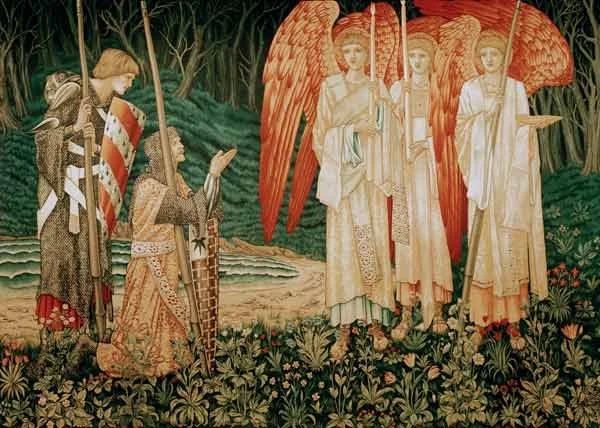
Attaining the Holy Grail , Tapestry by Sir Edward Burne-Jones
Galahad and the Grail is a very wholesome poem, as far as it genuinely feels like it contributes to wholeness. It feels, while I am reading it, as though my soul is made healthier. And I think that is on purpose. In the prelude, Malcolm Guite talks about “taking up the tale again” because of how much the land (that is, modern-day England) is sleeping and hurting and forgetting itself:
Take up the tale of courtesy,
take up the tale of grace.
Revive the land’s long memory,
summon the fair folk, let them be.
Something of Faerie, wild and free
still lingers in this place.
His solution to this forgetfulness—both of the wildness of Faerie, and of courtesy and grace—is to write a new Arthuriad. This is a terrifying task: think of all the different ways the King Arthur legend has been written and rewritten and re-rewritten.
We have the history of Geoffrey of Monmouth in the 12th century of an Arthur who is conquering and violent. There are the eerie and ethereal enchantments written in the ensuing two or three centuries by scattered French and German authors before the legends come to England. There also is the hearty, jovial, Christmassy Sir Gawain and The Green Knight. We have Sir Thomas Malory’s Le Morte Darthur in the 15th century, which is beautiful and massive and confusing and gut-wrenchingly full of suffering and human all at once. There’s the other world of Spenser, where vices and virtues become weird marble halls and vanishing dances. We have Tennyson’s glorious and military tragedy in Idylls of the King. And of course, there’s T. H. White’s devastating heroic existentialism in The Once and Future King.
Somehow, Guite manages to step into this tradition without a trace of self-consciousness. Galahad and the Grail is a ballad, which means that all of the sing-song sounds that a cynical modern poet (like me, sometimes) would disapprove of, are not only present in the poem but central to it. The rhythm is so palpable that, even if you aren’t reading it out loud (which you should, if you can manage it—preferably with a group), you’ll hear the poem’s drumbeats in your head. Every stanza has three rhymed lines back-to-back-to-back, which means that the sound of the poem is repetitive in a way that is almost chant-like:
“So good Sir Bors rode out once more
along the forest track
and told himself, “I’ve made my vow.
God speed me! I am for it now—
I’ve set my hand unto the plough.
There is no turning back.”
Note the rhyme within the first line—“Bors” with “more”—then step back to admire the rest. The poem feels like it is galloping, right along with the knights riding in it. The poetry does, maybe, once in a while come off as a little cheesy, but the poetry is so earnest and wholesome that one is reminded, like G. K. Chesterton, that a little cheese is part of a healthy diet.[1]
The earnestness of the verse itself pairs well with the atmosphere of the poem. Galahad and the Grail doesn’t paper over any of the central sinfulness to the traditional King Arthur story—Galahad himself, for instance, is born of Lancelot’s fornication with Elain, just like he is in some of the grittier tellings of the legend. Rather, running through Galahad and the Grail like one of England’s brooks, is the movement toward renewing the land: the wood-spirits and naiads the knights encounter are repeatedly dry or withdrawn within themselves.
Indeed, the Grail-quest in Galahad and the Grail departs in a key point from traditional tellings. In most accounts the knights pursue the Grail as an end in itself. When Galahad achieves the Grail in Malory, for instance, he is taken up into heaven, and the rest of the knights go home. T. H. White casts the Grail-quest as, effectively, something for Arthur’s rowdy knights to do, now that they’ve brought the giants under control. But Guite’s Grail-quest is something else entirely: it is urgent. Galahad does desire to find the grail because it is good, but the key point in Galahad and the Grail is that his finding of the grail will bring healing:
“For Galahad will take the quest
and will achieve, at our behest,
the Holy Grail, and heal the land
and with our Saviour rise and stand.”
In Galahad and the Grail, the quest for the Grail is also a quest to heal a wounded king, whose cursed wound prevents the whole land from growing whole again. Perhaps Guite, in creating a poem so full of wholeness, is hoping to inspire something similar. The quest for holiness is, of course, to be desired in itself, but Guite’s wholesome poetry suggests that healing a wounded land might just involve purity of heart.
[1]See the essay, “Cheese,” by G.K. Chesterton. Unfortunately, the five volumes which Chesterton intended to write on the subject were never completed.
Brendon Sylvester is a poet and writer based near Philadelphia, PA. He studied at the Torrey Honors College, where the likes of Edmund Spenser, Augustine, and the landscapes of the American National Parks influenced his imagination. His writing has appeared in Ekstasis, Touchstone, the Amethyst Review and elsewhere. He currently serves as a poetry editor for the Anselm Society. Find his July 2025 review of former Anselm board member J.C. Scharl's poetry collection, Ponds, here.
Enjoy More Arthurian Content!