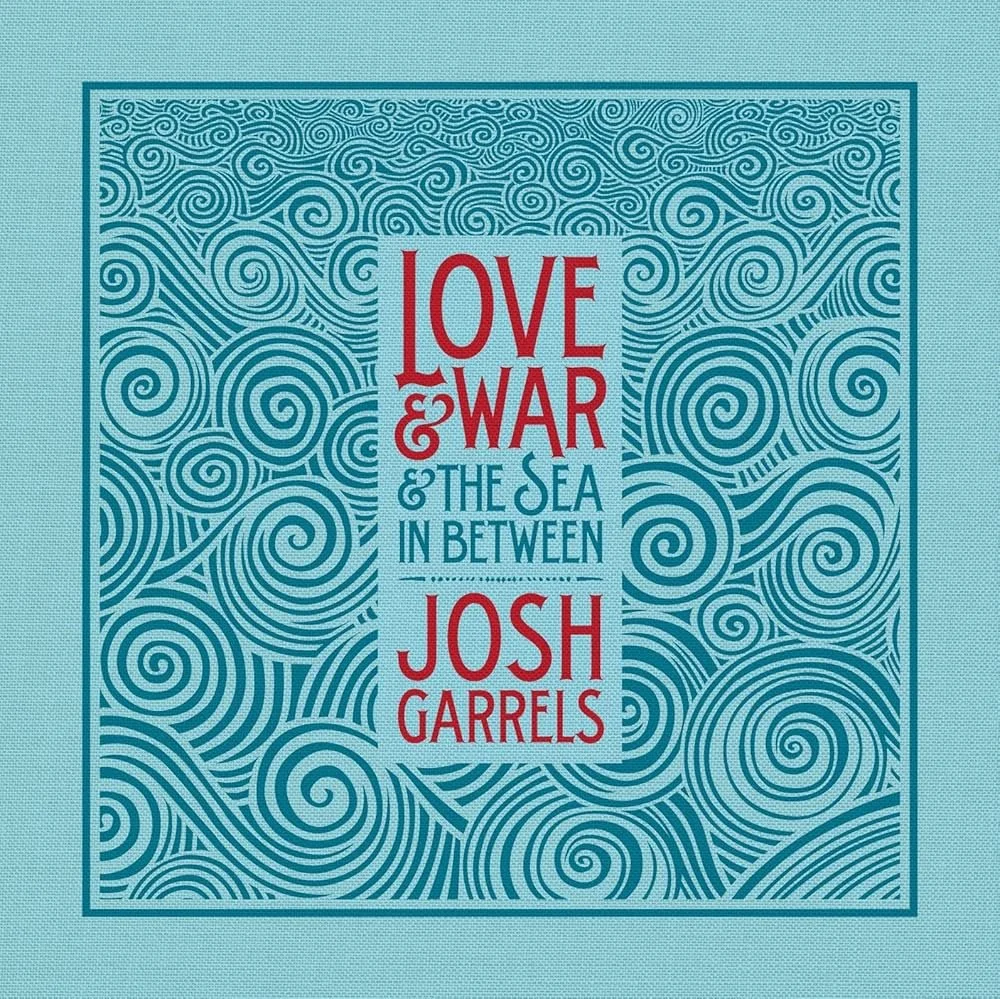
Dalton Olive revisits an older album from the songwriter and savors its co-creation of a reality charged with God.
By Dalton Olive
Few modern musicians embody the calling to sub-create as completely as Josh Garrels. His album Love & War & The Sea In Between stands as a compelling example in contemporary music; not because it constructs a fantasy world in the obvious sense, but because it renders reality itself as charged and alive with the presence of God.
From its opening moments, Love & War & The Sea In Between resists fragmentation. The album unfolds as a unified imaginative space, where recurring images like oceans, animals, wind, cities, fire are used to communicate deeper realities. These themes function less like metaphors and more like elements of world-building as the album progresses. This is one of the hallmarks of sub-creation. In Tolkien’s sense, a successful secondary world has an internal coherence, a kind of gravity that holds its symbols together.
Garrels achieves this not through elaborate lore but through artful consistency. The sea is never just the sea. It is distance, chaos, longing, baptism, judgment, and possibility, all at once. The effect is cumulative. By the time the listener reaches the latter half of the album, the imagery has taken on a life of its own. We are no longer interpreting symbols; we are connecting to an experience in real time.
One of the striking features of Garrels’ writing is how thoroughly it is shaped by Scripture without being reducible to quotes. His songs are not sermons set to a melody. They are imaginative re-articulations of biblical realities. In this way, Garrels shares an instinct with Tolkien himself. Neither artist is interested in allegory as a one-to-one system. Instead, both work by resonance. Biblical themes like exile, redemption, judgment, restoration are not just labeled; they are felt. They move beneath the surface of the songs. This is particularly evident in tracks like “Farther Along” and “The Resistance,” where the language of pilgrimage and conflict gestures toward a larger story.
Tolkien insisted that sub-creation is not morally neutral. To make a world is to make claims about what is good, what is broken, and what might yet be redeemed. Garrels’ album is deeply concerned with these questions, but it approaches them somewhat obliquely.
There is conflict in this world: war, resistance, fracture, but it is never sensationalized. Instead, it is woven into the fabric of the music as an ever-present tension. The “war” of the album’s title is not merely external; it is spiritual, interior, cosmic. Likewise, “love” is not sentimentality but a force that endures, pursues, and restores; what emerges is a moral vision. Listeners are not told what to think. They are given a world in which certain things ring true: that exile is real, that longing is meaningful, that redemption is possible. The production is simple but intentional. Acoustic instruments, space in the mix, layered vocals, it all gives the songs room to breathe. That space is important. It makes the album feel open rather than crowded. You’re not being pushed from one idea to the next. You’re given time to sit in it.
A lot of Christian art either explains too much or avoids depth altogether. Garrels does neither. He trusts the listener to do some work.
Love & War & The Sea In Between shows what it looks like to take both faith and craft seriously. It builds something consistent, lets it speak, and leaves space for the listener to enter in.
That’s a good example of what Tolkien had in mind. Not an imitation of his style, but alignment with his vision: making something that reflects reality truthfully enough that people start to see that reality differently.
Dalton is a writer, musician, counselor and pastor. Whether through writing, teaching, or music, his work blends together formation, storytelling, and an invitation to wholeness. He is currently living in Colorado Springs.