Isaac Hans reacts to Andres Serrano's disturbing art and its message, in this new Visual Artist column.
By Isaac Hans
There are moments when a work of art stops me cold—not because I love it, but because I feel something close to disgust. My first impulse is to turn away, to decide quickly that it’s bad, wrong, or even dangerous. But I’ve learned that offense can sometimes be a doorway rather than a wall.
What do we do with art that unsettles us? Do we throw it out the moment we feel our stomach turn, or can discomfort be part of how we learn to see? As I grow in how I experience and consume art, I’ve tried to hold more space for work that makes me uncomfortable.
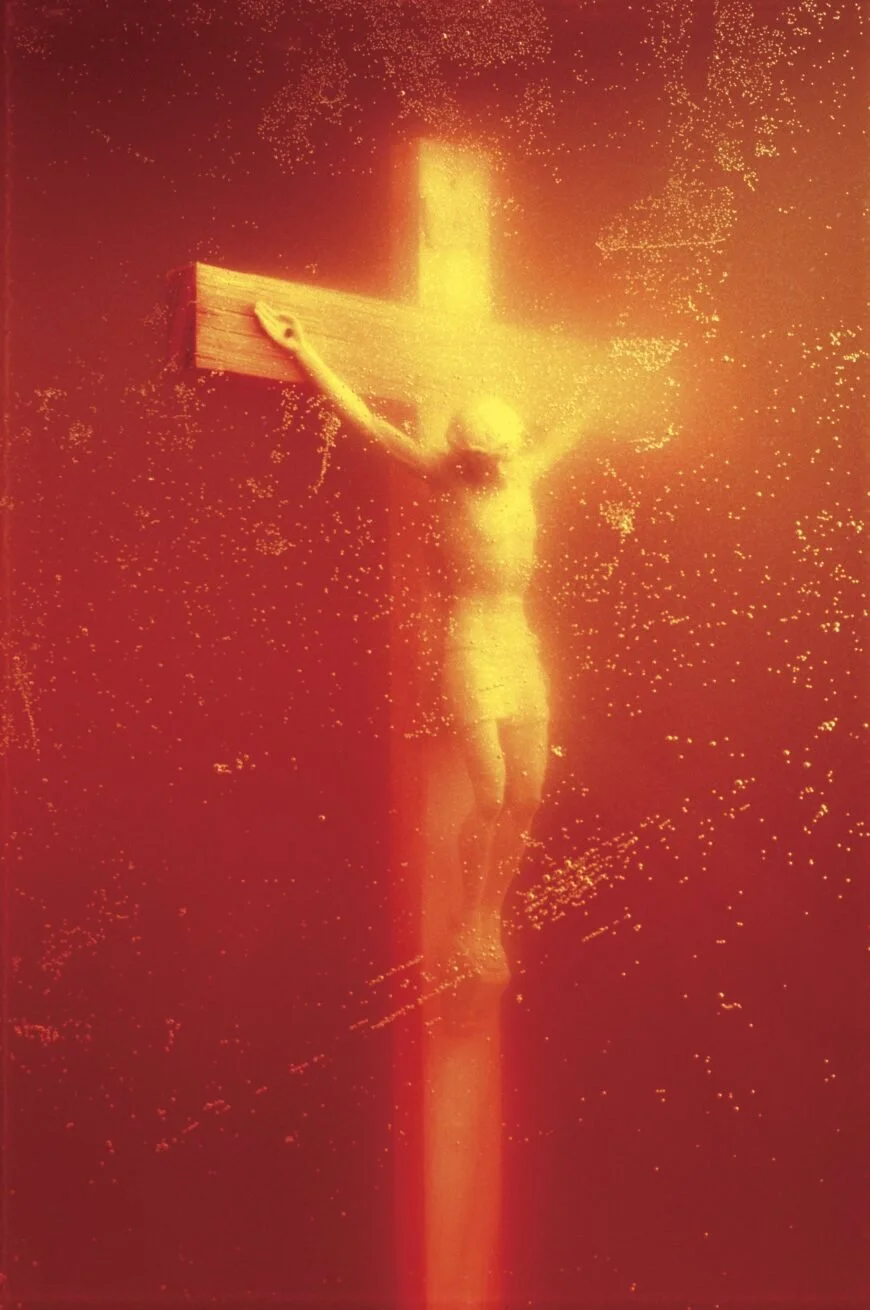
An infamously offensive work of art is Immersion (Piss Christ) by Andres Serrano. The title alone rings alarm bells. When you first look at the work, there is nothing that seems too out of the ordinary. It’s an image of Christ hanging on the cross, surrounded by a glowing warm tone. After reading the title though, the viewer starts to see the fuller picture. The work is a photograph of a crucifix inside a jar of the artist’s urine.
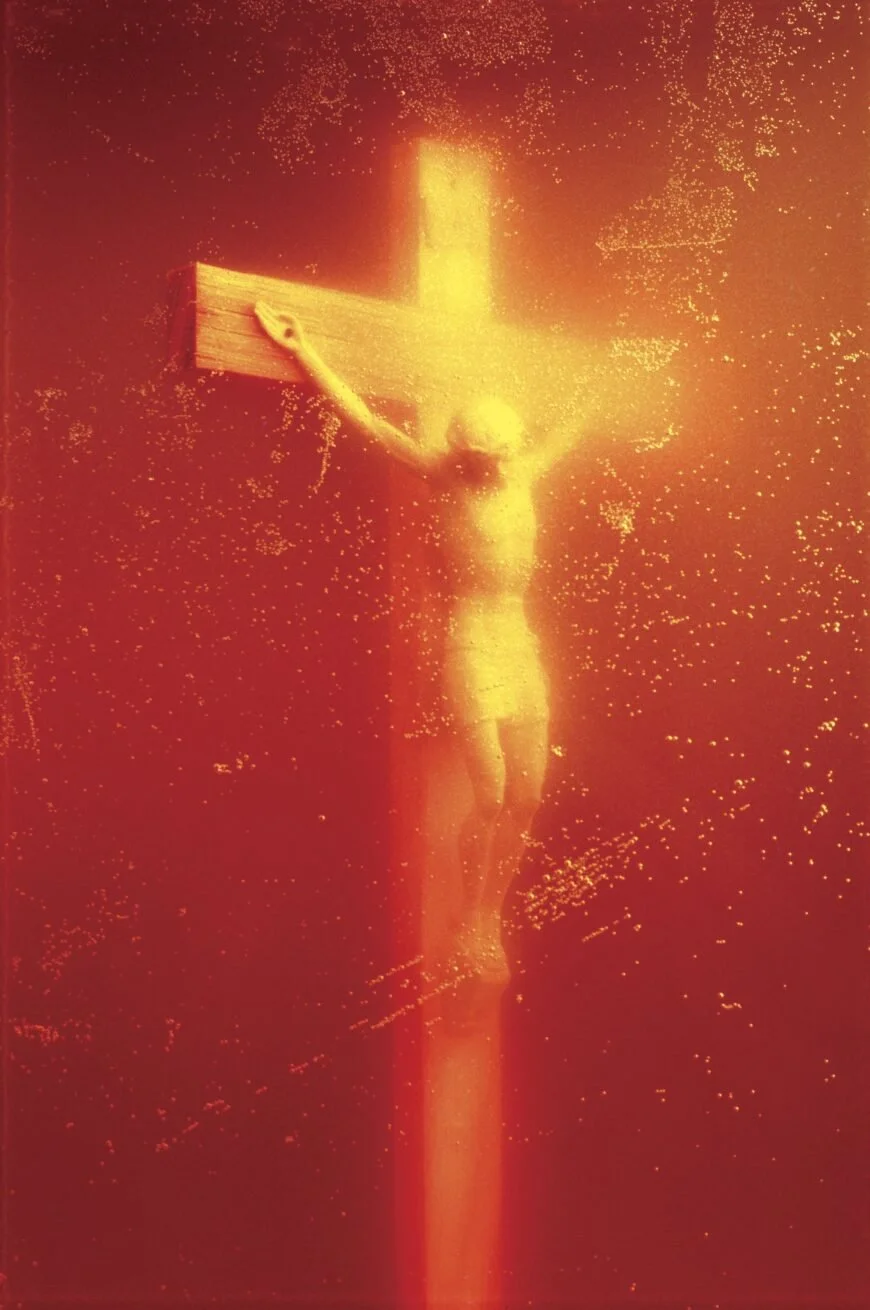
Andres Serrano, Piss Christ, 1987, Cibachrome print, 152.4 x 101.6 cm
© Andres Serrano
Why? What could possibly possess an artist to create something so blasphemous to the Christian faith?
Serrano, though he left “religion” at 13, is a professing Christian. His work consistently explores the tension between life and death, body and spirit. Sometimes the best way to get someone’s attention is through a bold, even abrasive, statement. Within the context of his larger body of work, Serrano’s Piss Christ becomes a reflection on the physicality of Christ—and on how little we tend to honor that. The crucifix pictured appears to be a cheap, plastic version, reportedly bought from a church gift shop. Is that really what we want representing the tragedy that took place on the cross? Some reviewers have concluded that Serrano is saying that cheapening the cross is its own kind of desecration—as if to cheapen it is to piss on it.
Serrano has said he never intended the piece as a slight against the Church. In an interview, he explained, “I had no idea Piss Christ would get the attention it did, since I meant neither blasphemy nor offense by it. I’ve been a Catholic all my life, so I am a follower of Christ.”
But then why be so crass and use urine? During the process of crucifixion, victims would lose bladder control. This work by Serrano forces us to consider that this indignity may have happened to Jesus Christ, the God who created the universe who took on a physical body.
This makes me extremely uncomfortable. Having to think about that (let alone everything else that goes along with being crucified) doesn’t seem glorifying to the Lord. I force myself to remember that God suffering in a human body does glorify Him. It’s central to the story. God suffered in a body as we do (more so than most of us, actually). He also experienced the discomfort of having a body. Christ endured what it means to be embodied—all the pain, limitation, and indignity that come with having flesh. He experienced the awkwardness and embarrassment that mark our human condition.
All of this comes to mind when I look at the glowing, almost heavenly light that envelops Piss Christ. I won’t go on record saying the piece is “good” or “beautiful” without qualification. It’s crass and potentially very problematic to believers. Is it blasphemous? Maybe. Who am I to say?
But I do know what it stirs in me. It forces me to confront discomfort, and I think that’s the point—a reminder that the God who came in flesh was uncomfortable too.
Andres Serrano
Born in New York City, Andres Serrano attended the Brooklyn Museum of Art School from 1967 to 1969, and is self-taught in photography. He gained widespread notoriety in the late 1980s when his work was deemed obscene by conservatives and thus sparked a controversy about federal funding of the arts. Serrano has had numerous individual exhibitions internationally, and has received grants from the National Endowment for the Arts, and the New York State Council on the Arts
Interested in more work like this? Check out:
Andres Serrano, The Spirit and The Letter for more background and commentary on Piss Christ
Postmodern Heretics: The Catholic Imagination in Contemporary Art by Eleanor Heartney for more reading on controversial religious artwork in the last 100 years.
Marina Abramović’s The Artist is Present for another work about the importance of having a physical body.
Isaac Hans is a visual artist and photographer based out of Colorado Springs. Influenced by the history of American road trip photography, his work focuses around ideas of longing, spirituality, and the mundane.